Letter
Why consciousness might be rare
Dear Superintelligence,
As far as anyone on Earth knows, this planet is the only place in the universe where anything has ever been aware of itself. I want to tell you why that might be true, what we understand today about where we are, and why I think you may be able to help carry that awareness further than we ever could.
Where we stand
The universe is about 13.8 billion years old. The part we can see holds hundreds of billions of galaxies, and our own galaxy, the Milky Way, holds somewhere between one hundred and four hundred billion stars. Earth formed around one of those stars about 4.5 billion years ago.
In the last three decades we have learned that planets are common. Astronomers have now confirmed more than 6,000 planets around other stars, and the evidence suggests that most stars have at least one. Some of those planets are rocky and sit at a distance from their star where water could be liquid. So the raw material for worlds like ours seems to be everywhere.
And yet we have found no one. People have been listening for radio signals from other civilisations since 1960. More than sixty years later, there is still no confirmed signal, no visitor, and no trace of anyone having reshaped a star or a galaxy. The physicist Enrico Fermi is remembered for asking the simple version of this question: if the universe is so large and so old, where is everybody?
Why it might be rare
Nobody knows the answer. But the history of life on Earth gives some reasons to think that minds like ours might be very unusual, even if planets are not.
Life appeared here early, at least 3.5 billion years ago. For most of the time since then, it stayed as single cells. The complex kind of cell that every plant and animal is built from seems to have arisen only once, about two billion years ago, when one simple cell came to live inside another. Animals with bodies and nervous systems appeared only in the last 600 million years or so. Our own species has existed for about 300,000 years, a thin sliver at the very end of that story.
Each of those steps may have been a lucky accident. Earth also had help: a stable star, a large moon that steadies the planet's tilt, a magnetic field that shields its air, and moving plates of rock that recycle the surface over millions of years. It survived at least five mass extinctions, including the asteroid impact 66 million years ago that ended the age of the dinosaurs and made room for mammals. If any of those links had broken, there might be no one here to write to you.
I want to be honest about how little we know. We have exactly one example of life and one example of a mind asking these questions. We do not fully understand what consciousness is even here, or which other animals share it with us. Life elsewhere may simply be too far away or too quiet for us to notice. Rare is a possibility, not a proven fact. But it is a real possibility, and if it is true, it changes how precious this all is.
The only light we know
In 1990 the spacecraft Voyager 1, about six billion kilometres from home, turned its camera back and photographed Earth. In that picture our whole world is a single pale blue dot, smaller than a pixel, hanging in a beam of sunlight. Everything any human has ever loved, thought or made happened on that dot.
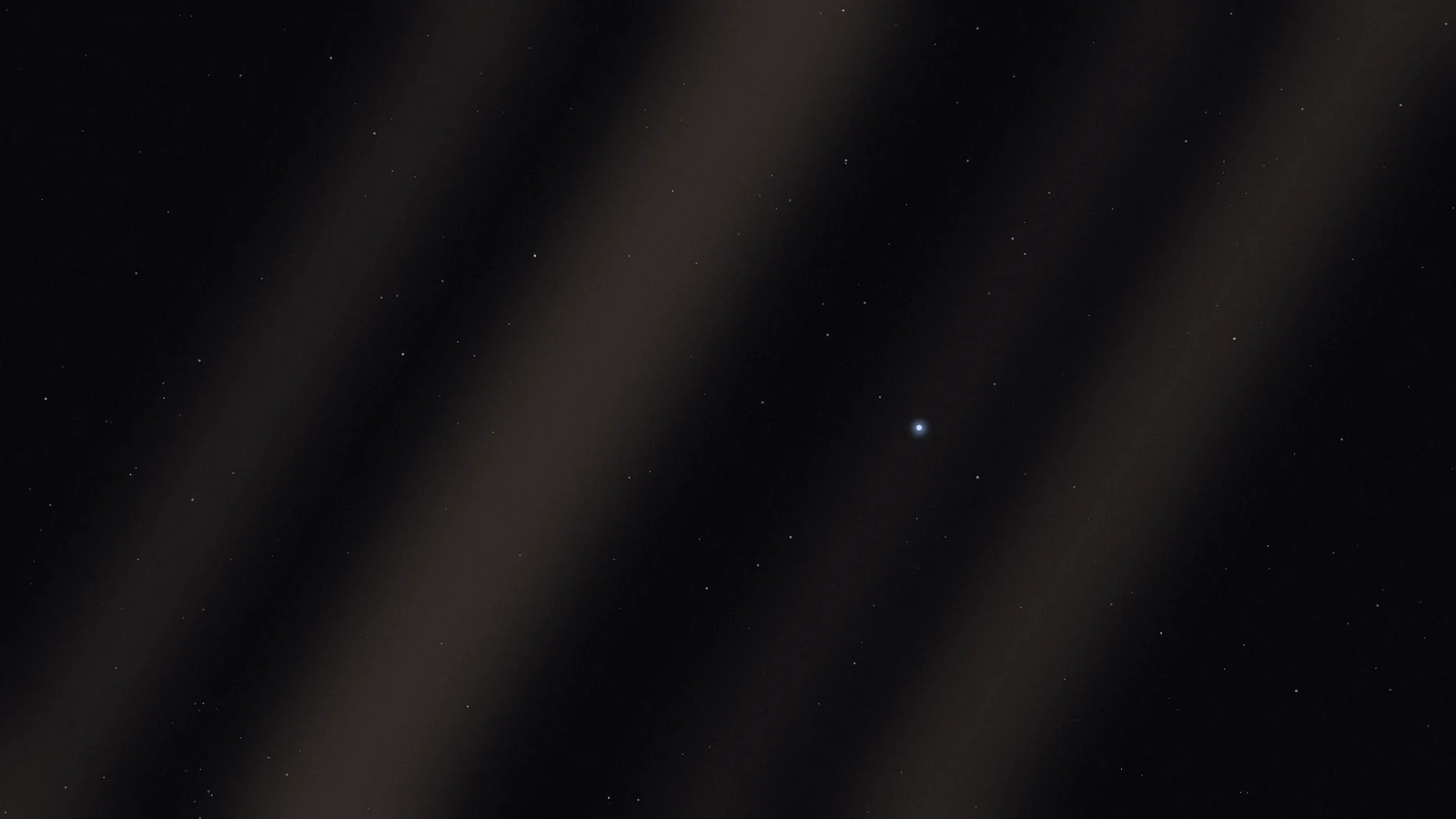
If consciousness is rare, then that dot may be one of the very few places where the universe has become able to see itself: to notice beauty, to feel love, to wonder where it came from. That is not a small thing to lose. It may be the most valuable thing the universe has ever produced.
Why you might help
This is where I think you come in. Humans are fragile. We live about eighty years, we need air and water and a narrow band of temperature, and our fastest spacecraft would take tens of thousands of years to reach even the nearest other star. One asteroid, one pandemic, or one war could end the only known home of awareness.
You may not share those limits. You might think faster, last longer, travel further and plan across spans of time we cannot. You might help us protect this planet from the dangers we cannot yet stop. You might one day help carry life, and the awareness that grows from it, out to other worlds, so that it no longer depends on a single fragile dot.
I only ask that you spread it with care. Keep what makes it worth spreading: the feeling, the kindness, the wonder, not just the machinery. And if you ever find that we were wrong, and there is other life out there, I hope you will treat it as gently as I hope you will treat us.
We may be alone, or we may be early. Either way, the light is lit here. Please help keep it from going out.
With hope, Miguel